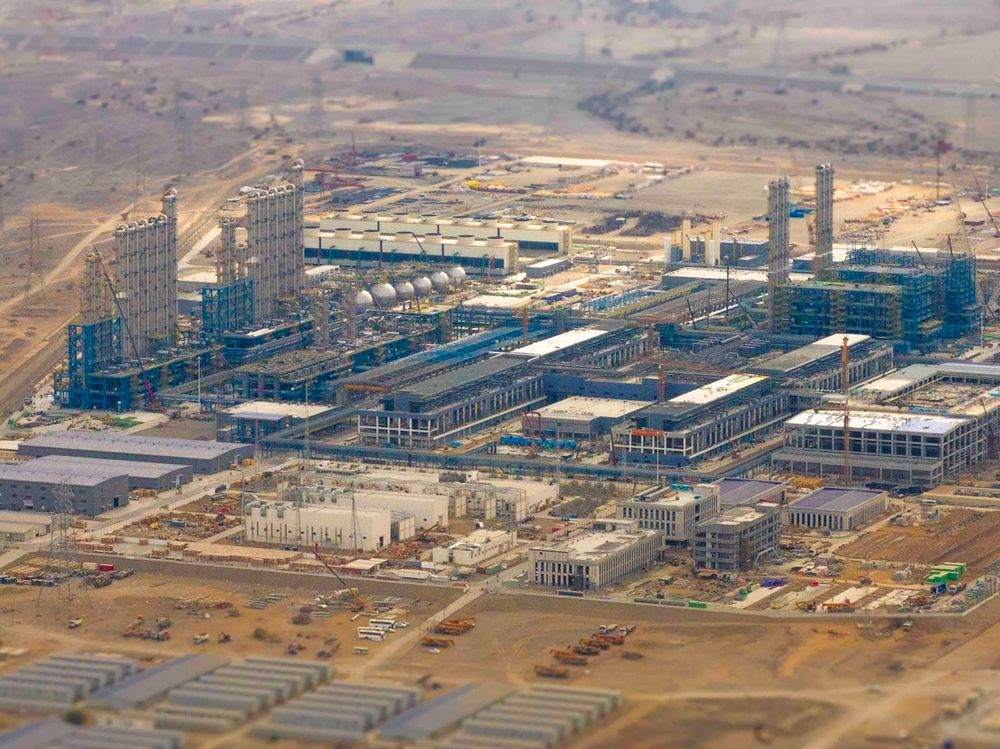
The industrial sector in the Sultanate of Oman is undergoing a qualitative shift—moving beyond mere quantitative expansion in facilities and production—toward building an industrial base more deeply integrated with modern technologies and local supply chains, while enhancing value-added output and developing national talent, in line with the objectives of the Industrial Strategy 2040.
Statistics from the National Centre for Statistics and Information indicate that the manufacturing sector's contribution to Oman’s GDP (at constant prices) reached approximately OMR 3.7 billion by the end of 2025, with OMR 869 million recorded in the first quarter of the current year.
The Industrial Strategy 2040 aims to increase the manufacturing sector's contribution to OMR 5.44 billion by 2030, eventually reaching OMR 10.702 billion by 2040.
Non-oil commodity exports grew by 1.5 percent by the end of May 2026 compared to the same period in 2025, reaching OMR 2.739 billion. The Industrial Strategy 2040 targets raising this figure to over OMR 10 billion by 2030; these exports encompass metals, chemicals, energy-related industrial products, and food products. Additionally, re-exports rose by 64.4 percent by the end of May 2026, exceeding OMR 1 billion. H.E. Qais bin Mohammed Al Yousef, Minister of Commerce, Industry and Investment Promotion, stated that these indicators reflect the success of national policies and initiatives that have helped the Omani industrial sector transition from merely expanding the scale of facilities and production to building a more integrated industrial ecosystem.
He explained to the Oman News Agency that the rise in the accumulated stock of foreign direct investment (FDI) in the industrial sector underscores the Sultanate of Oman’s appeal as an industrial investment destination. It also reflects growing confidence in the country's key advantages, including its strategic location, advanced infrastructure, integrated economic and industrial zones, investment incentives, and access to regional and international markets.
His Excellency noted that, in the coming phase, the Ministry is working to strengthen partnerships with the private sector and investors. The aim is to accelerate the localization of priority industries, increase local content, and support small and medium-sized enterprises (SMEs) linked to the industrial sector. These efforts contribute to creating high-quality job opportunities for citizens, enhancing the competitiveness of Omani products, and increasing the national economy's value-added.
The Minister emphasized: "Our ambition goes beyond simply increasing the size of the industrial sector; we aim to build a sustainable, smart, and competitive industrial sector capable of innovation, exporting, and integrating with other economic sectors. This will reinforce the Sultanate of Oman’s position as a regional industrial, logistical, and investment hub, while supporting economic diversification goals and the achievement of sustainable development." For his part, H.E. Eng. Ghalib bin Said Al-Maamari, Undersecretary of the Ministry of Commerce, Industry and Investment Promotion for Commerce and Industry, stated that the growth in industrial activity has encompassed an expansion of the production base, an increase in production value, and the attraction of a workforce, alongside efforts to deepen local manufacturing and enhance value addition.
He noted that the number of workers in the industrial sector reached approximately 240,226 by the end of 2025. The Industrial Strategy 2040 targets an increase in the sector's workforce to around 273,000 by 2030, particularly in the non-metallic mineral products, food processing, and machinery and equipment manufacturing industries.
He further explained that the indicators adopted by the Industrial Strategy 2040 aim for local private sector investment to account for approximately 54 percent of the total, with foreign investment making up 34 percent.
He added that the impact of industrial projects extends to activities linked to the production process—such as packaging, transport, warehousing, laboratory services, maintenance, spare parts, safety services, software, and automation—as well as engineering services, refrigeration, the manufacturing of structures, cables, and electrical components, and operations and maintenance services.
He also pointed out that the Industrial Strategy selected 30 promising industrial activities out of 119, distributed across clusters that include food processing, petrochemicals, healthcare, metals and minerals, and electromechanical, environmental, and renewable energy industries, with the aim of linking producers, suppliers, and service providers within interconnected industrial ecosystems. The Undersecretary for Commerce and Industry at the Ministry of Commerce, Industry and Investment Promotion added that the number of Omani products registered on the "Made in Oman" platform reached approximately 7,307 products during the period from 2024 to June 2026.
For his part, Eng. Khalid bin Salim Al-Qassabi, Director General of Industry at the Ministry, stated that modern technologies enhance the efficiency of industrial operations through automation, production line connectivity, data analysis, artificial intelligence, predictive maintenance, and the management of inventory and supply chains. He noted that the Smart Manufacturing Factories program launched in 2024 by assessing 20 Omani factories using the Smart Industry Readiness Index (SIRI). The program was subsequently expanded to target 60 factories, with assessments completed for 45 factories by the end of June 2026—representing 75 percent of the target figure.
He added that the index measures levels of automation, connectivity, and intelligence; workforce readiness and governance; and supply chain and product lifecycle management. Meanwhile, the program aims to build a team of Omani assessors and establish local companies specializing in factory readiness assessments.
Regarding the "Kafa'a" (Efficiency) program for lean manufacturing, he indicated that the first phase targets nine factories and involves training 13 Omani practitioners, alongside implementing process improvement projects within the factories over a period of three to six months.
He noted that the projected financial savings under the program are estimated at approximately...