

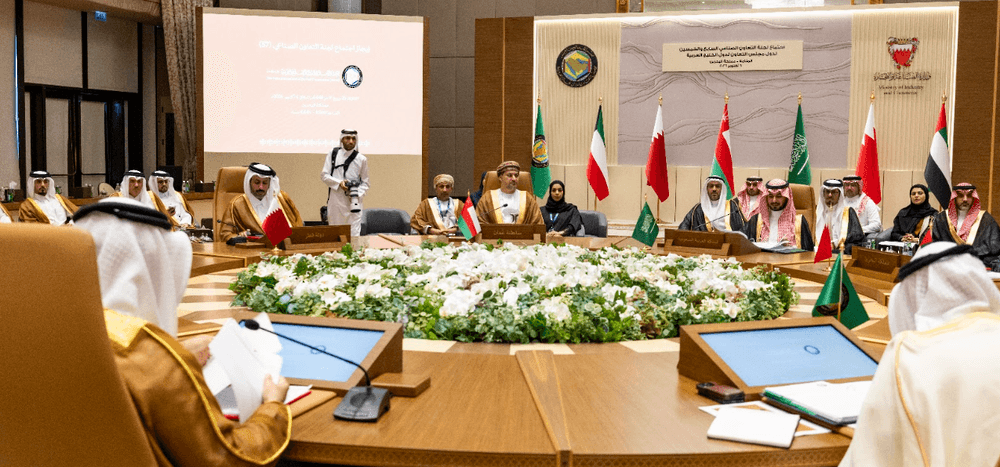
The Sultanate of Oman participated in the meetings of the Gulf Cooperation Council (GCC) ministers responsible for trade, industry, and standardization, held today in the Kingdom of Bahrain. The meetings addressed various economic and regulatory issues aimed at enhancing Gulf integration, developing the trade and industrial environment, improving the efficiency of the standardization system, and expanding the private sector's role in joint economic efforts.
The Sultanate of Oman’s delegation was led by H.E. Eng. Ghalib bin Said Al Maamari, Undersecretary of the Ministry of Commerce, Industry and Investment Promotion for Commerce and Industry. The delegation included representatives from the Ministry of Foreign Affairs, the Authority for Small and Medium Enterprises Development (Riyada), the Consumer Protection Authority, the Oman Chamber of Commerce and Industry, and other officials.
The proceedings included the 57th meeting of the Industrial Cooperation Committee, the 71st meeting of the Commercial Cooperation Committee, and the 12th meeting of the Ministerial Committee for Standardization Affairs. Additionally, the agenda featured the 15th consultative meeting between GCC trade ministers and the heads of GCC chambers and federations, as well as the 6th consultative meeting between GCC ministers of trade and industry and Gulf entrepreneurs.
H.E. the Undersecretary emphasized that these joint GCC meetings represent a significant milestone in advancing economic integration among member states. He noted that they aim to elevate trade and industrial cooperation to broader levels, thereby enhancing the competitiveness of the Gulf economy and fostering a more integrated environment for the private sector and joint Gulf investments. His Excellency stated that the Sultanate of Oman is committed to continuing its collaboration with GCC states to develop an interconnected Gulf economic system. This system aims to facilitate the movement of trade and national products, enhance integration across production and supply chains, and expand opportunities for industrial and commercial enterprises. He emphasized the importance of transforming joint initiatives and programs into projects that deliver tangible economic impact.
The 57th meeting of the Industrial Cooperation Committee addressed several strategic issues concerning the future of the Gulf industrial sector. Key topics included a study on establishing strategic Gulf reserves for food, pharmaceuticals, and other essential supplies; finalizing discussions on the definition of a "Gulf national product"; the implementation plan for lists of goods subject to collective protection measures; and revised regulations regarding customs duty exemptions for industrial inputs.
The meeting also reviewed updates on the Gulf Center for the Fourth Industrial Revolution project and the digital transformation of factories in the region, as well as the development of the institutional structure of the Gulf Organization for Industrial Consulting (GOIC), alongside other initiatives aimed at deepening industrial integration among GCC states.
Furthermore, the meeting discussed a joint Omani-Kuwaiti proposal to address workforce localization standards based on industrial sectors and their respective levels of maturity. This proposal seeks to strike a balance between enhancing value-added contributions, encouraging localization, and boosting the competitiveness of Gulf products. Eng. Khalid bin Salim Al-Qassabi, Director General of Industry at the Ministry of Commerce, Industry and Investment Promotion, emphasized that the Sultanate of Oman views Gulf industrial integration as a key enabler for building a more competitive and sustainable production base. He highlighted the importance of developing regulatory frameworks for Gulf national products that account for the nature and maturity levels of various industrial sectors, while incentivizing factories to increase value-added output and enhance local content.
He added that the topics under discussion reflect a drive to deepen inter-industry linkages within the Gulf, enhance supply chain resilience and industrial security, and accelerate the adoption of Fourth Industrial Revolution technologies and digital transformation in manufacturing facilities. These measures aim to boost production efficiency and strengthen the competitiveness of Gulf industries in regional and international markets.
On the trade front, the 71st meeting of the Commercial Cooperation Committee addressed several issues aimed at developing the Gulf Common Market, facilitating the smooth flow of intra-Gulf trade, and improving the regulatory environment for business, trade, and investment.
The meeting reviewed progress on unified rules for regulating e-commerce across GCC states, aiming to establish a more integrated Gulf framework for electronic commercial transactions; recommendations included urging member states to finalize work on these unified rules before the end of December 2026.
Furthermore, the meeting discussed various matters related to trade and investment cooperation among GCC states, seeking to unify efforts and enhance the competitiveness of the GCC as an integrated economic bloc. The Sultanate of Oman participated in the 12th meeting of the Ministerial Committee for Standardization Affairs. The meeting addressed the development of the Gulf standardization system and the enhancement of the quality and safety of products circulating in the markets—measures designed to support industry and trade while facilitating the movement of goods among GCC states.
The agenda included the approval of 25 draft Gulf technical regulations—prepared by the Standardization Organization in collaboration with national standardization bodies and Gulf technical committees—as well as discussions on the Gulf Standardization Organization’s draft budget for the 2027 fiscal year, support for the Gulf Accreditation Center, the policy for allocating financial surpluses, and various related regulatory and technical matters.
These efforts contribute to the harmonization of standards and technical regulations, the elevation of quality and conformity levels, and the facilitation of market access for Gulf products, thereby enhancing their competitiveness.
For her part, Dr. Jumana bint Saeed Al-Busaidi, Director of the GCC Affairs Department at the Ministry of Commerce, Industry and Investment Promotion, emphasized that meetings of GCC ministerial committees serve as a vital pillar in developing the joint Gulf economic framework. This is achieved by unifying efforts, aligning regulatory frameworks and policies, and monitoring the implementation of initiatives and decisions that foster integration among member states and boost their economic competitiveness.
She noted that the topics discussed reflect the breadth and interconnectedness of Gulf cooperation, as well as efforts to enhance the smooth flow of intra-regional trade, industrial integration, and the regulation of trade.
